Dr. Rose Opiyo Delivers Lecture at Duke University, USA, on Evidence-Based Interventions for ‘At-Risk Children’ and Adolescents in Kenya
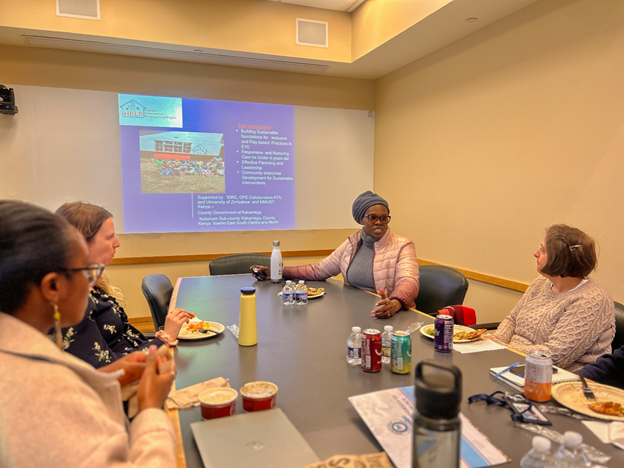
The Associate Dean, School of Education, Dr. Rose Opiyo on 28th January 2026, delivered a compelling lecture at Duke University’s Sanford Center for Child and Family Policy in the United States. Her lecture titled ‘Developmental Outcomes, Drivers, and Interventions: A Focus on At-Risk Children and Adolescents in Kenya,’ focused on evidence-based interventions that can improve child and adolescent development, particularly in vulnerable settings in Kenya and across Africa.
Dr. Opiyo was invited to Duke University in Durham, North Carolina, for a two-week scholarly visit from 18th to 31st January, 2026, by Research Scientist Dr. Emily B. Reilly, with whom she is collaborating on a grant-funded research project. The study is supported by a ‘2×2 Grant for Early Career Scholars’ awarded by the International Society for the Study of Behavioral Development, with mentorship from Dr. Kenneth A. Dodge.
The collaborative project analyzes data drawn from two longitudinal studies to examine pathways to adult educational attainment and mental health among adolescent parents, with a particular focus on the influence of childhood and early adolescent factors. The visit was critical to the timely completion of the grant objectives, enabling in-depth data analysis, accelerated interpretation of findings, and the preparation of a manuscript for submission to a peer-reviewed academic journal.
In her lecture, Dr. Opiyo presented findings from her extensive research on parental support and play-based learning interventions derived from one of her outstanding projects, ‘Inclusive Home-Based Early Learning (iHELP)’ replicable model that translates research into sustainable practice. She emphasized the central role parents and caregivers play in promoting nurturing care for children under the age of four. She also highlighted how structured parental support and responsive care-giving practices can significantly improve developmental outcomes, especially among children growing up in resource-constrained environments.
Further, Dr. Opiyo explained the application and impact of these interventions in various African countries, noting that her project primarily targets young children, adolescent girls, and women in rural Kenyan communities. She underscored the importance of translating research into scalable, community-driven interventions that can inform policy and practice. Her presentation introduced Duke researchers to a community-driven model rooted in bio cultural learning and indigenous knowledge systems. This approach challenges conventional deficit-based paradigms that often characterize Global North-South research partnerships.
While at Duke University, Dr. Opiyo also engaged with faculty members and researchers. She participated in scholarly presentations, strengthening her professional network and advancing her research training. The visit provided her with hands-on experience in the analysis of large, rigorously designed longitudinal datasets, as well as exposure to advanced quantitative statistical methods for addressing developmental psychology research questions.
Additionally, Dr. Rose Opiyo had the opportunity to interact and share insights with Prof. Jennifer E. Lansford, the President of the Society for Research in Child Development (SRCD). Prof. Lansford is the S. Malcolm Gillis Distinguished Research Professor of Public Policy and Director of the Center for Child and Family Policy at Duke University’s Sanford School of Public Policy in North Carolina. Her research focuses on examining how cultural contexts shape and moderate parental influences on social and behavioral development from childhood through adulthood.
Notably, Dr. Rose Opiyo’s research portfolio has attracted substantial international funding from reputable institutions, including the International Development Research Council, British Council, British Institute, European Union, Institute of International Education, Carnegie Corporation of New York (CCNY), and the Africa Early Childhood Network.
She is a recipient of prestigious fellowships from the ISSBD/Jacobs Foundation, German Academic Exchange Service (DAAD), Carnegie Africa Diaspora Fellowship Program, and the Leaders of Africa Institute Research Impact Fellowship. This exemplifies her zeal as a leading voice in developmental research and policy engagement.